Environmental learning is more effective when students investigate a real-world environment.
L’Aquàrium de Barcelona is a marine environmental education centre, where students deepen their knowledge of the Mediterranean through activities adapted to each educational stage.
The activities reinforce school curriculum content without altering class planning and with clearly defined educational objectives.
Discover a complete educational programme on the sea and its conservation
How to choose a marine environmental education activity
Quick guidance by age and learning objectives
First select the educational level, then review the duration, content, and methodology to ensure integration into your teaching programme.
All activities follow a scientific inquiry approach and adapt language, dynamics, and analytical depth to students’ cognitive development.
Educational programmes by school level
Resources adapted to student development
Activities are structured by educational level to facilitate understanding of the marine environment:
Select the educational level to view the corresponding programme:
Sensory discovery of the marine environment through guided observation and first connections with nature
Mediterranean ecosystems, biodiversity, and species adaptation
Ecological relationships, human impact, and ecosystem balance analysis
Hypothesis formulation, data collection, and scientific argumentation in a real context
Summer schools in Barcelona
Flexible education in a non-school context
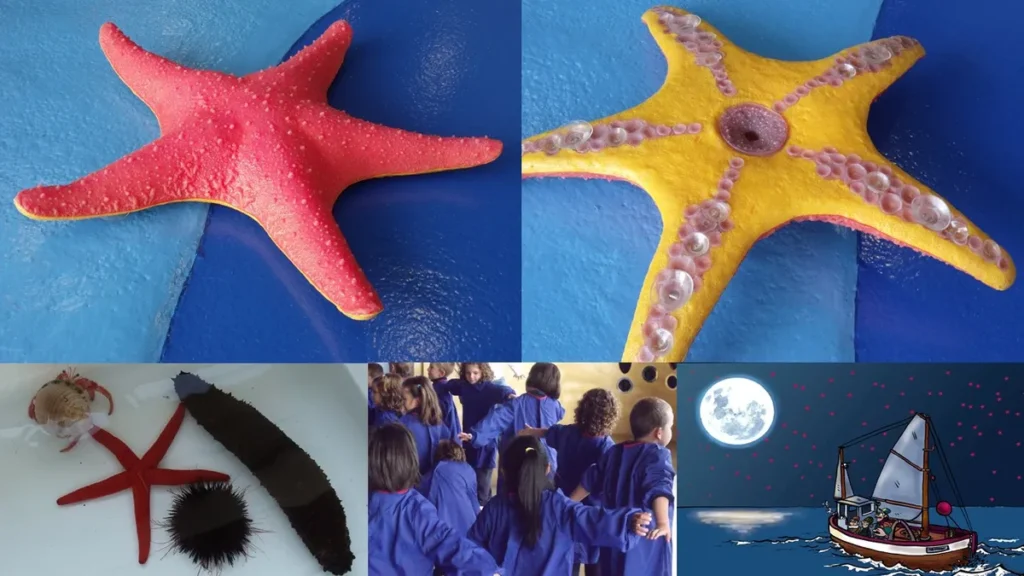
During summer, L’Aquàrium offers educational programmes for summer schools and leisure groups with a participatory and discovery-based approach.
Participants explore Mediterranean biodiversity and develop respect for the environment through guided activities adapted to informal contexts.
This pedagogical approach allows students not only to observe but also to interpret the marine environment, connect it to prior knowledge, and understand their role in protecting the Mediterranean.
Check programme details and availability for summer schools:
Educational project and scientific methodology
The first step to raising ecological awareness
L’Aquàrium de Barcelona is part of the Pedagogical Innovation Council (CIP) and has held an educational quality label since 2016.
Its approach integrates science, sustainability, and critical thinking into school curricula, generating long-term impact on marine conservation.
Discover the pedagogical foundations behind our educational programme
Natural science school visits in Barcelone
School visits at L’Aquàrium de Barcelona provide learning in a real environment through direct observation of living organisms and Mediterranean ecosystems.
During the activity, students analyse adaptations, trophic relationships, and the effects of human activity on the marine environment, linking classroom content to a guided scientific experience.
The programme is designed as a curricular activity complementing subjects such as natural sciences, biology, and scientific culture, following a rigorous educational approach based on scientific inquiry.
Educational outing contextualised in the Mediterranean
What students learn during the visit
The combination of games, workshops, storytelling, and special visits transforms students into young researchers.
Learning outcomes include:
- Identifying Mediterranean biodiversity and adaptations
- Interpreting ecological relationships and food webs
- Applying the scientific method through observation and hypothesis formulation
- Analysing human impact on the marine environment
- Arguing conservation measures based on evidence
- Developing environmental responsibility
These skills align with SDG 13 (Climate Action) and SDG 14 (Life Below Water), integrating science, sustainability, and critical thinking.
Scientific and environmental skills developed
Resources to prepare the school visit
Teachers are provided with structured educational materials to integrate the visit into lesson planning without increasing workload. Resources cover three stages:
- Pre-visit preparation activities
- Observation activities during the visit (teacher guide, educational dossier)
- Post-visit reflection and assessment exercises
Access ready-to-use materials in the corresponding programme
The educational team supports teachers in planning to ensure alignment with curricula and optimal learning outcomes.
Access additional resources
Before, during, and after the activity
Teacher training days
A special day during which teachers learn about the school curricula, tour the center’s facilities, and explore new teaching approaches.
Teachers’ Day
Invitation to discover the centre
A personalised visit with an educator explaining methodology and resources available at L’Aquàrium de Barcelona.
Training sessions designed to introduce educational methodologies, spaces, and activities, with the aim of promoting their integration into the school curriculum.
L’Aquàrium also provides a general visitor guide
Training sessions to discover methodologies and activities
Why work on marine environmental education in Barcelona
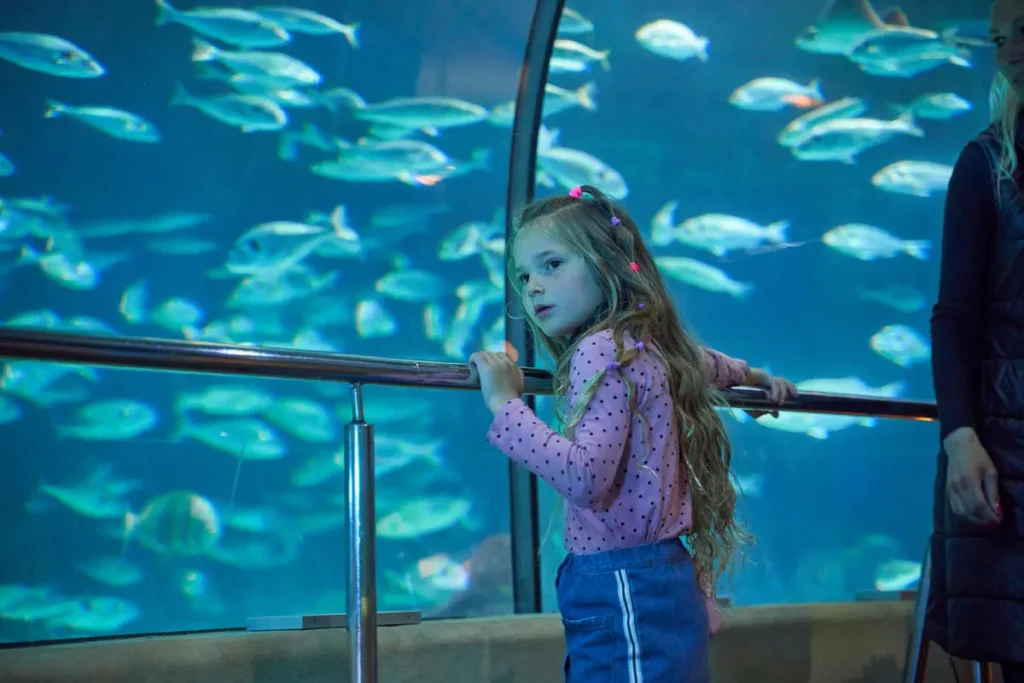
Barcelona, as a Mediterranean city, has a direct historical connection with the sea. This makes the marine environment a key educational resource to understand biodiversity and address real challenges such as pollution and conservation.Working from a local context enhances critical thinking, scientific understanding, and responsible citizenship.
Approaching these topics with students through a local, familiar context fosters critical thinking, enhances scientific understanding, and helps build engaged citizenship committed to sustainability and the protection of the Mediterranean.
Local context and meaningful learning
Frequently asked questions for teachers
Practical information before organising your visit
School visit duration
The duration depends on the educational level and the type of educational activity Usually lasting 45 to 120 minutes, auxquelleto which we can add some time for a self guided tour to complete the visit exhibitions
Alignment with the school curriculum
The educational programmes are designed in alignment with the scientific and environmental competencies of the current official school curriculum, which facilitates their integration into classroom planning.
Prior preparation of students
It is not mandatory, but it is recommended to cover some basic concepts about the sea and ecosystems.
Teachers are provided with preparatory educational materials to contextualise the visit and enhance its pedagogical value.
Post-visit classroom work
Each programme includes proposed activities to analyse what has been observed, reflect on the impact of human activity, and consolidate scientific learning
Group size
Activities are organised in guided educational groups in order to encourage participation and direct observation. At the time of booking, the recommended number of students per educator is specified.
Available languages
Educational visits can be conducted in several languages depending on availability, mainly in Catalan and Spanish.
Students with specific needs
The educational team adapts the pace and dynamics of the activity to promote inclusion and group participation. It is recommended to indicate this at the time of booking in order to prepare the activity appropriately.
Teaching environmental education in a real environment
Learning in a real-world context facilitates the understanding of complex ecological processes and improves knowledge retention, as students connect theory with observable reality.
Difference between self-guided and guided school visits
The guided visit includes a specialised educator, defined learning objectives, and inquiry-based activities.
The self-guided visit consists solely of free exploration of the exhibition.
Booking the activity
Booking is made by specifying the activity, educational level, number of students, and preferred dates:
- Via the contact
- Email reserva@aquariumbcn.com
- Phone: 93 221 74 74 (Reservations Department)
Learn more about the Mediterranean Marine Centre
- What is L’Aquàrium de Barcelona ?
- Would you like to join our team?
- Marine environmental conservation and research
Conecta con el mar: experiencias, eventos y actualidad marina
Quick access to educational levels: